

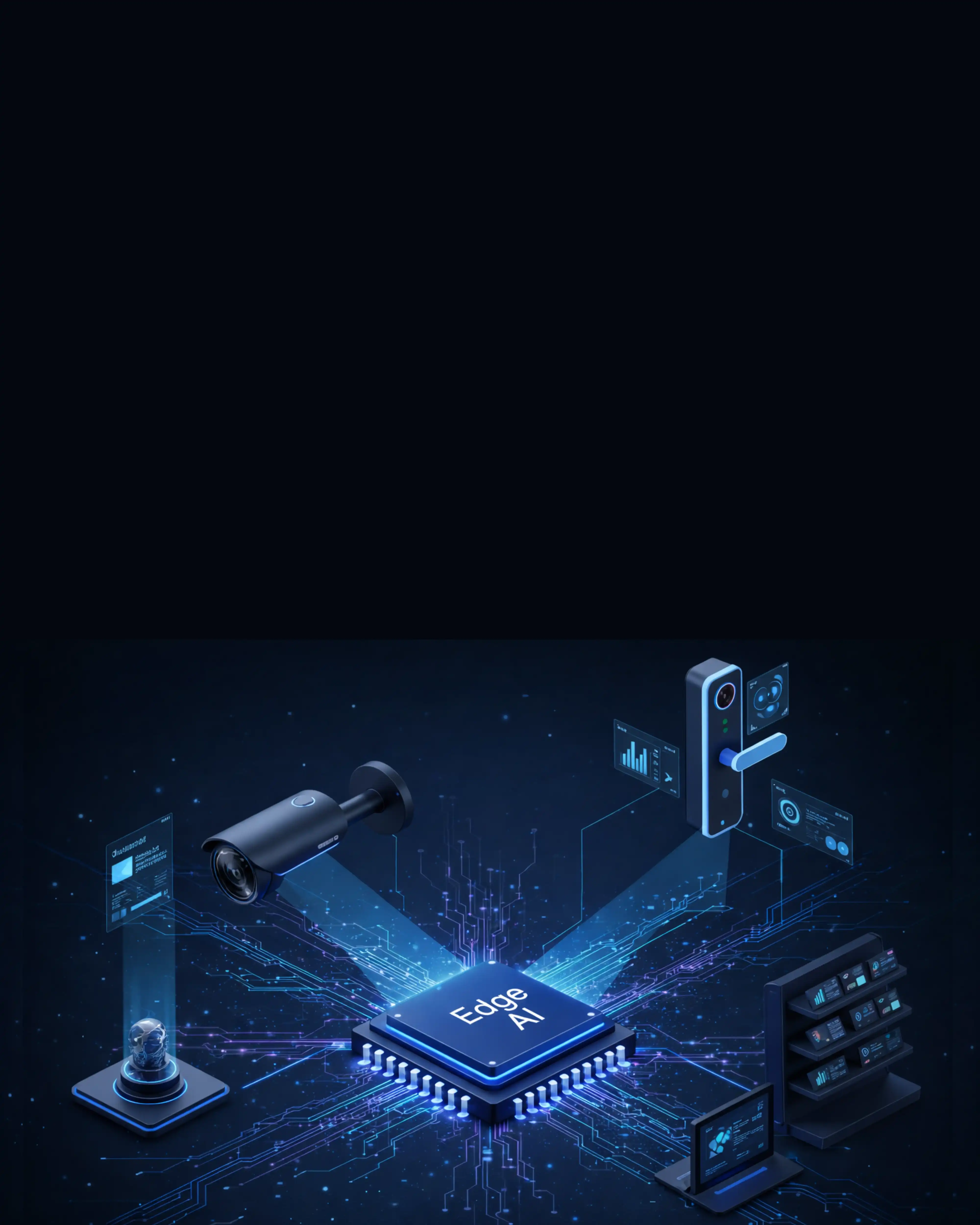
Technical Highlights
- Comprehensive 3D Vision AI: Supports structured light, ToF, and binocular fusion for precise facial recognition and live detection
- High-Performance Edge AI: Multicore processing delivers real-time intelligence for demanding IoT and security applications
- Ultra-Low Power Efficiency: Always-on IoT and smart locks with reliable, long-lasting performance
- Seamless Multimedia & Fast Boot: Integrated imaging, audio, and instant startup deliver smooth, responsive experiences
- Compact & Integrated: Advanced 3D vision, AI, and memory in one compact, cost-efficient design
T2M100
The Clarity™ T2M100 is a Deep Neural Network (DNN)-based Environmental Noise Cancellation (ENC) chip designed to deliver high-quality voice capture in challenging acoustic environments. The chip performs advanced noise suppression using a single microphone, enabling clear voice communication even in windy or noisy industrial conditions.
With ultra-low power consumption of approximately 150 µA, compact silicon die size, and software-free integration, the T2M100 enables seamless deployment of AI-powered noise cancellation in space-constrained edge devices and wearables. Its architecture allows manufacturers to easily integrate high-performance ENC directly into microphone modules or compact hardware designs.
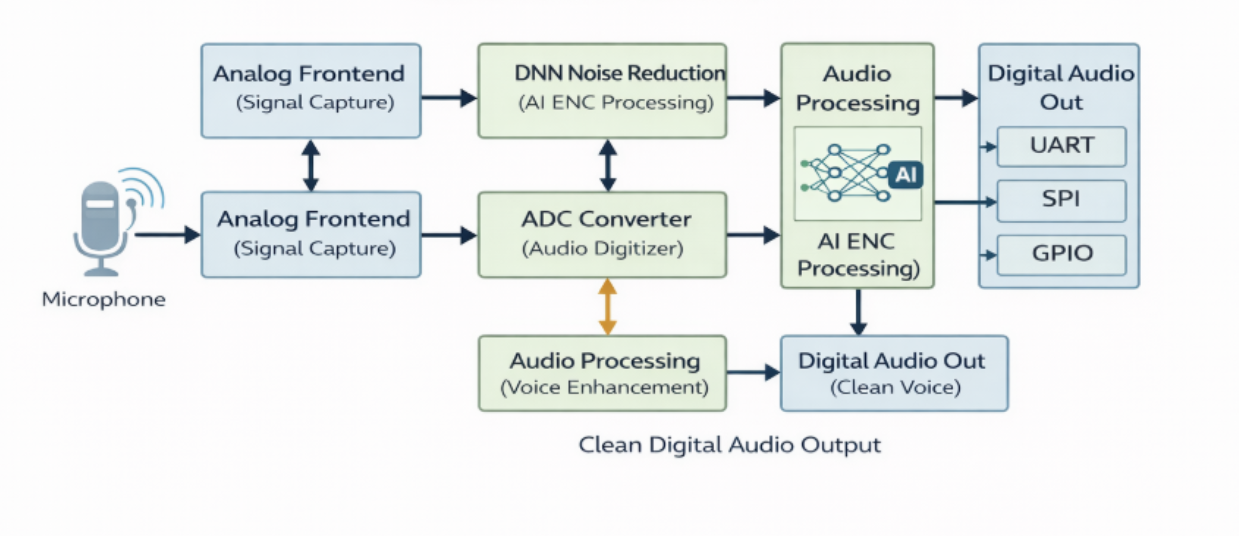
- Protocol: AI-based Environmental Noise Cancellation (Single-Mic ENC)
- MCU: Integrated AI processing engine with DNN inference capability
- SRAM: On-chip memory optimized for neural network processing
- Flash: Embedded firmware-free architecture (no external code required)
- Rich Interface: Digital microphone interface for seamless module integration
- Supply Voltage: Ultra-low-power operation optimized for edge devices
- Working Current: ~150 µA ultra-low power consumption
- Sleep Current: Ultra-low standby power for always-on devices
- Tx Maximum Power: Optimized for low-power audio signal processing
- Rx Receive Sensitivity: High-precision voice capture with strong noise suppression
- Security Mechanism: Hardware-level processing with embedded AI inference engine
Applications
- True wireless stereo (TWS) earbuds
- Smart wearables
- Wireless headsets
- Voice-enabled IoT devices
- Smart home assistants
- Industrial communication devices
Product Specifications
Product Selection Tool| Part No. | Protocol | MCU-MHz | SRAM (KB) | Flash (KB) | SPI | I2C | I2S | GPIO | UART | USB | ADC | Voltage | PKG | NODE |
|---|---|---|---|---|---|---|---|---|---|---|---|---|---|---|
| T2M100A10 | Used for Noise suppression(not a wireless chip) | - | - | - | - | Yes | - | - | - | - | - | 1.8 V - 1.98 V | DFN 10 3x3 | - |
T2M130
Listen™ T2M130 is an ultra-low power Deep Neural Network (DNN) based keyword spotting (KWS) chip designed for always-on voice interfaces in edge and wearable devices. The device integrates Voice Activity Detection (VAD) and keyword detection in a highly power-efficient architecture, enabling battery-powered products to remain continuously listening while consuming minimal energy. With an always-on power consumption as low as ~20 µA, the T2M130 enables reliable wake-word detection and AI voice interaction for next-generation smart devices. Its optimized AI inference engine makes it ideal for voice-controlled consumer electronics, wearables, and smart home devices that require continuous listening without impacting battery life.
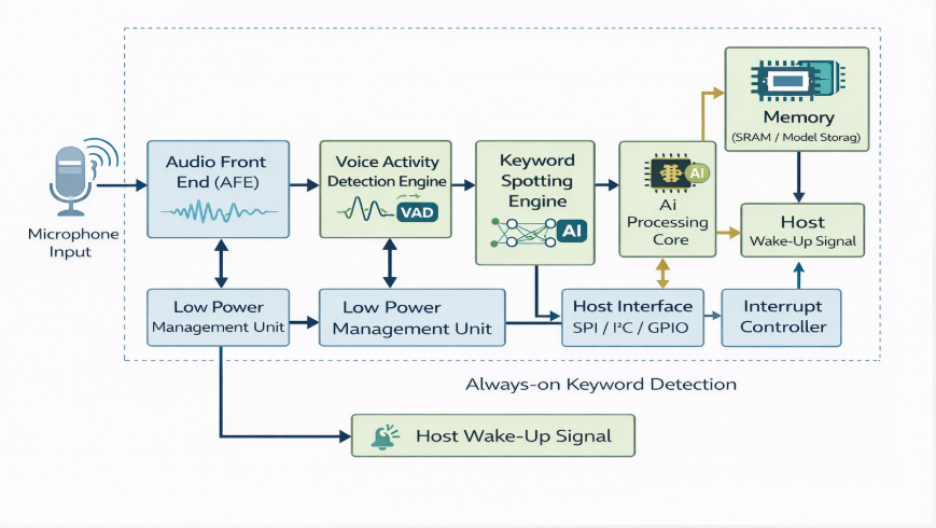
- Protocol: Voice Activity Detection (VAD), Keyword Spotting (KWS), AI Voice Processing
- MCU: Integrated low-power AI processing engine for keyword detection
- SRAM: On-chip memory optimized for neural network execution
- Flash: External host-controlled model and firmware storage
- Rich Interface: Microphone input, SPI, I²C, GPIO interrupt interface
- Supply Voltage: Optimized low-voltage operation for battery-powered devices
- Working Current: Ultra-low power consumption in always-on listening mode
- Sleep Current: ~20 µA always-listening standby mode
- TX Maximum Power: N/A (No RF transmitter – AI audio processing chip)
- RX Receive Sensitivity: High-accuracy voice detection with integrated audio processing
- Security Mechanism: Secure AI model execution and protected firmware interface
Applications
- Smart speakers
- Voice-activated wearables
- Smart home devices
- Voice-controlled consumer electronics
- Smart toys & interactive devices
- Always-on AI voice interfaces
Product Specifications
Product Selection Tool| Part No. | Protocol | MCU-MHz | SRAM (KB) | Flash (KB) | SPI | I2C | I2S | GPIO | UART | USB | ADC | Voltage | PKG | NODE |
|---|---|---|---|---|---|---|---|---|---|---|---|---|---|---|
| T2M130A12 | Advanced AI Keyword Spotting (KWS) SoC | - | - | - | - | Yes | - | - | - | - | - | 1.8 V - 1.98 V | DFN 12 3x3 | - |
T2M5007
The T2M5007 is a highly integrated edge AI SoC designed for real-time 3D facial recognition and intelligent vision processing. It combines structured-light depth processing with dedicated neural network acceleration to enable secure, on-device biometric authentication without cloud dependency.
Optimized for low power consumption and fast system response, the T2M5007 performs depth calculation, image processing, and AI inference locally, delivering reliable recognition performance while reducing system latency and power requirements. Its compact and efficient architecture makes it ideal for next-generation smart access, security, and intelligent IoT edge devices requiring accurate and secure identity verification.
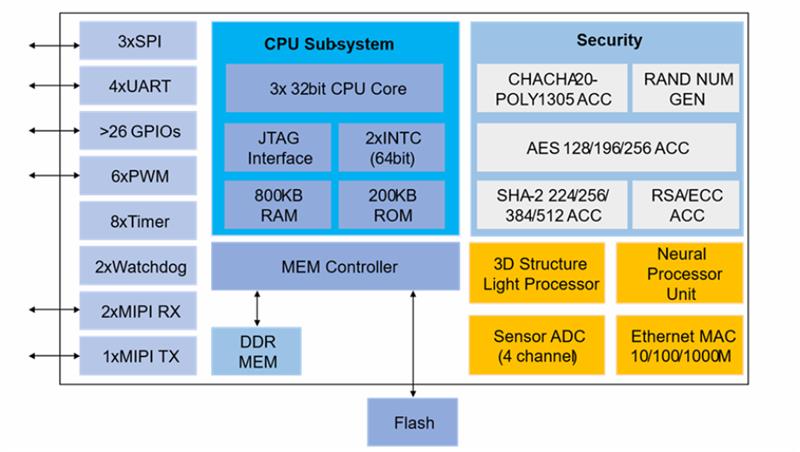
- Protocol: Supports AI vision processing and 3D structured-light sensing interfaces (non-wireless processing SoC)
- MCU: Integrated multi-core processing architecture with dedicated Neural Network Unit (NPU) for edge AI computation
- SRAM: On-chip memory architecture optimized for neural network inference and real-time image processing
- Flash: External storage supported for firmware and AI model deployment
- Rich Interface: MIPI TX high-speed interface for connection to external application processors and vision systems
- Supply Voltage: Low-power optimized operating design suitable for embedded AI edge devices
- Working Current: Dynamic power consumption < 400 mW during AI processing operations
- Sleep Current: Standby power consumption < 100 µW enabling always-on intelligent sensing
- TX Maximum Power: Not applicable (device does not include RF transmission)
- RX Receive Sensitivity: Not applicable (no wireless receiver integrated)
- Security Mechanism: Supports secure local AI processing and device-side data handling for privacy-sensitive biometric applications
Applications
- Intelligent door locks
- Facial recognition payment terminals
- Smart access control systems
- Service robots
- Edge AI vision devices
Product Specifications
Product Selection Tool| Part No. | Protocol | MCU-MHz | SRAM (KB) | Flash (KB) | SPI | I2C | I2S | GPIO | UART | USB | ADC | Voltage | PKG | NODE |
|---|---|---|---|---|---|---|---|---|---|---|---|---|---|---|
| T2M5007A68 | - | 350 | 192 | 16MB* | 4 | 3 | 2 | 26 | 4 | Yes | Yes | 3.3V | QFN68 8x8 | - |
T2M5008
The T2M5008 is a high-performance multimodal 3D vision processing chip designed for advanced depth sensing and intelligent vision applications. It uniquely supports binocular ToF, binocular structured light, and structured light + ToF fusion processing.
Built on a self-developed multi-core RISC-V architecture, the chip delivers high-throughput image processing, low-power computing, and integrated neural-network acceleration, enabling accurate sensing and real-time AI vision performance in complex environments.
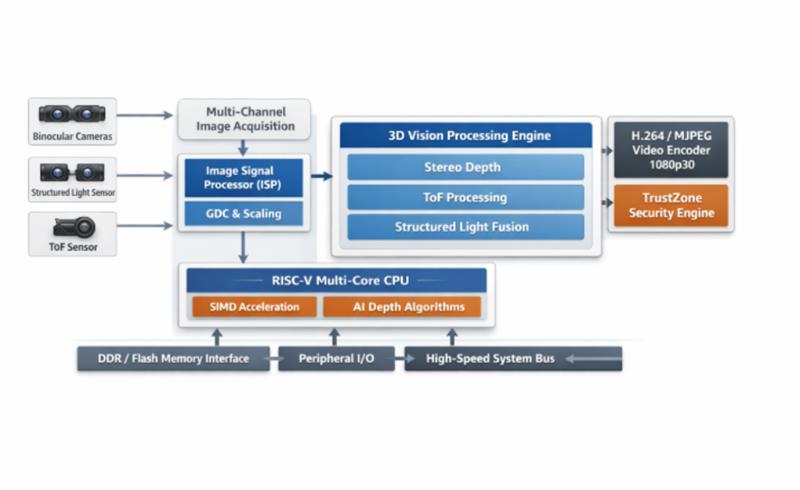
- Protocol: Binocular ToF, Binocular Structured Light, Structured Light + ToF Fusion Processing
- MCU: Multi-core self-developed RISC-V processor with SIMD acceleration
- SRAM: On-chip high-speed system memory (optimized internal SRAM architecture for vision processing)
- Flash: External flash supported (SPI NOR flash interface)
- Rich Interface: MIPI CSI, MIPI DSI, USB, SPI, I²C, UART, GPIO, PWM
- Supply Voltage: Typical core and I/O multi-rail power architecture (≈ 1.1V core / 3.3V I/O, system dependent)
- Working Current: Depends on processing workload and sensor configuration (application dependent)
- Sleep Current: Low-power standby mode supported (application dependent)
- TX Maximum Power: N/A (No RF wireless transmitter)
- RX Receive Sensitivity: N/A (No RF wireless receiver)
- Security Mechanism: TrustZone security architecture, hardware encryption engine, secure boot, side-channel attack protection
Applications
- Intelligent door locks (3D facial recognition)
- Facial-recognition payment terminals
- Service robots
- Intelligent vacuum cleaners
- Smart access control systems
- AI vision edge devices
- Industrial 3D sensing solutions
Product Specifications
Product Selection Tool| Part No. | Protocol | MCU-MHz | SRAM (KB) | Flash (KB) | SPI | I2C | I2S | GPIO | UART | USB | ADC | Voltage | PKG | NODE |
|---|---|---|---|---|---|---|---|---|---|---|---|---|---|---|
| T2M5008A88 | - | 350 | 192 | 16MB* | 2 | 3 | 2 | 26 | 4 | Yes | Yes | 1.8 V - 3.3 V | QFN88 9x9 | - |
T2M5301
The T2M5301 is a high-performance edge-AI voice processing SoC designed for intelligent offline speech recognition and real-time human–machine interaction. Built on a multi-core 32-bit RISC-V architecture with an integrated Neural Network Unit (NNU), it enables low-latency voice wake-up, speech recognition, and natural language processing without cloud connectivity.
Optimized for always-on operation, the device delivers efficient power consumption and reliable local AI performance for automotive, smart home, robotics, and intelligent edge devices. With flexible audio interfaces and scalable computing capability, T2M5301 provides a secure and responsive platform for next-generation voice-enabled systems.
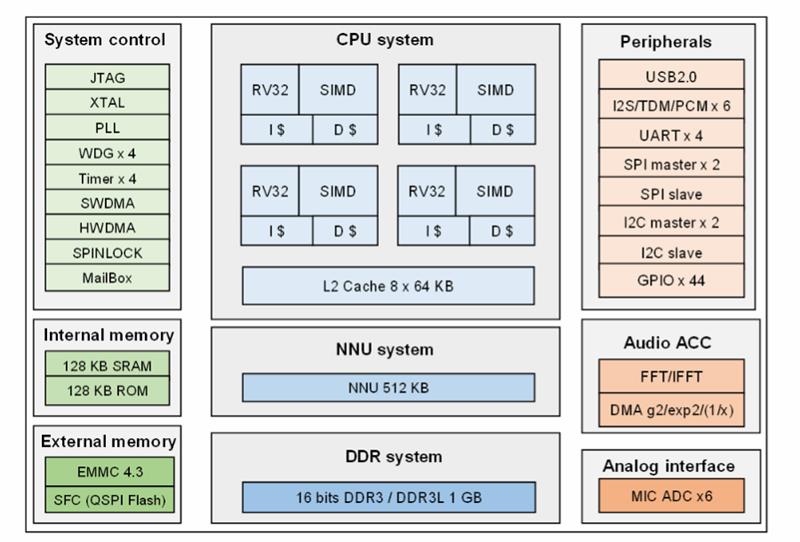
- Protocol: AI voice processing and offline speech recognition (non-wireless processor)
- MCU: Four 32-bit RISC-V CPUs @ 400 MHz with dedicated Neural Network Unit (NNU)
- SRAM: Internal system memory optimized for AI audio processing (external DDR supported)
- Flash: External storage supported via eMMC boot and USB firmware download
- Rich Interface: Analog Microphone input, I²S, TDM audio interfaces, USB interface
- Supply Voltage: Multi-rail low-power SoC architecture (application dependent)
- Working Current: Depends on AI workload and voice processing operation
- Sleep Current: Low-power always-on voice standby supported
- TX Maximum Power: N/A (No RF transmitter)
- RX Receive Sensitivity: N/A (No RF receiver)
- Security Mechanism: Secure firmware boot and protected local AI processing architecture
Applications
- Automotive voice assistants (car-grade voice control)
- Smart home voice interaction devices
- AI voice robots
- Smart appliances with offline voice control
- Intelligent human–machine interaction terminals
Product Specifications
Product Selection Tool| Part No. | Protocol | MCU-MHz | SRAM (KB) | Flash (KB) | SPI | I2C | I2S | GPIO | UART | USB | ADC | Voltage | PKG | NODE |
|---|---|---|---|---|---|---|---|---|---|---|---|---|---|---|
| T2M5301 | - | - | 128 | 128 | 2 | 2 | 6 | 44 | 4 | 1 | - | - | - | - |
All Part Numbers
Global Search
| Series | Supplier Part No. | Protocol | MCU-MHz | SRAM (KB) | Flash (KB) | SPI | I2C | GPIO | USB | ADC | Datasheet |
|---|---|---|---|---|---|---|---|---|---|---|---|
| T2M100 | T2M100A10 | Used for Noise suppression(not a wireless chip) | - | - | - | - | Yes | - | - | - | N/A |
| T2M130 | T2M130A12 | Advanced AI Keyword Spotting (KWS) SoC | - | - | - | - | Yes | - | - | - | N/A |
| T2M5007 | T2M5007A68 | - | 350 | 192 | 16MB* | 4 | 3 | 26 | Yes | Yes | N/A |
| T2M5008 | T2M5008A88 | - | 350 | 192 | 16MB* | 2 | 3 | 26 | Yes | Yes | N/A |
| T2M5301 | T2M5301 | - | - | 128 | 128 | 2 | 2 | 44 | 1 | - | N/A |